

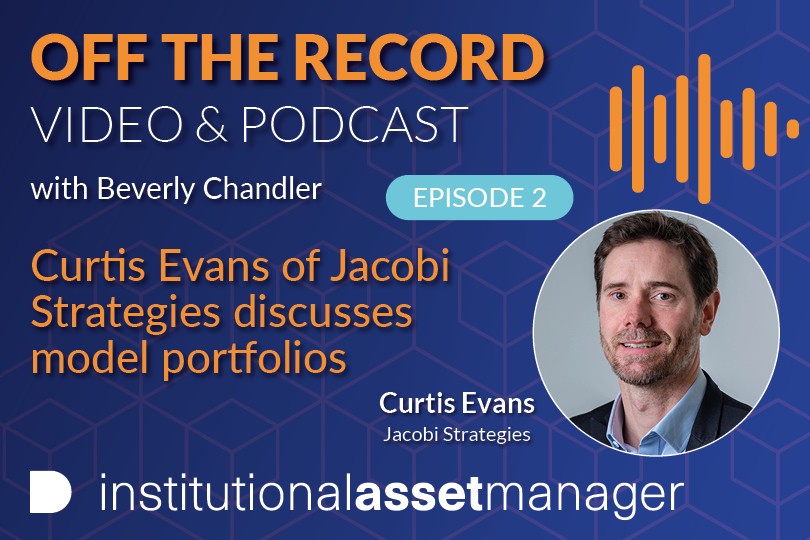
Curtis Evans of Jacobi Strategies, explains to Institutional Asset Management’s Beverly Chandler, how the firm’s offering works with model portfolios.
This episode is brought to you in partnership with Jacobi Strategies.
Listen on Apple Podcasts Listen on Spotify
Transcript
Beverly Chandler
Hello, my name’s Beverly Chandler, and I welcome you to this edition of the Off the Record podcast and video for Institutional Asset Manager in partnership with Jacobi Strategies. I’m here with Curtis Evans, Managing Director EMEA of Jacobi Strategies. It’s a global investment technology firm focused on multi-asset portfolio design, analytics, model management, and client engagement. Today’s episode is all about model portfolios, their rapid rise across wealth and institutional asset management, and the challenges that come with scaling them. We’ll start by hearing from Curtis about his role at Jacobi Strategies, and then we can unpack what’s driving global adoption, where the pain points lie, and how technology is reshaping operating models. From governance and compliance to automation and transparency, we’ll cover the practical steps firms can take to streamline processes and deliver consistent outcomes. So Curtis, welcome to the show, and can you tell me a little bit about yourself and your role within Jacobi Strategies?
Curtis Evans
Yeah, hi, Beverly, and thanks for having me. So my name is Curtis Evans, so I’m the Managing Director for EMEA here at Jacobi, so I’ve been building out the office, our UK office. Come from an asset management background myself and having worked for large asset managers. And I guess I experienced on that side the pain point and the opportunity that was investment technology, but very excited over the last five years to be working for an investment technology company, and especially in this kind of newer world with newer technologies led by AI coming into the fore.
Beverly Chandler
And tell me what’s really happening in the model portfolio space right now? What’s driving growth and where are some cracks starting to emerge?
Curtis Evans
Yeah, I think it depends a little bit on where you’re sitting. But you do hear a lot about model portfolios and I think sometimes there is a connotation or an expectation that model portfolios is very much a retail wealth management phenomenon, but that’s definitely not just the case. We’re seeing explosive growth in model portfolios globally across both wealth management and institutional asset management. I think there are commonalities, but there’s also some subtle distinctions. So for instance, on the institutional asset management side, what’s happening is that model portfolios are being used as a conduit for the investment decision-making; and it’s allowing investment teams to operate at more at scale, centralise their investment decisions into fewer models and then propagate those changes down to the underlying funds, managed accounts. So in the institutional space, model portfolios are really a conduit to scale. Contrast that in wealth management where model portfolios, particularly say here in the UK, they’re a product in itself. So for instance, the MPS market or the Managed Portfolio Service market, where models going onto platforms become the end experience for a retail investor. So when they go to an advisor, put into a model portfolio, and what they see and feel is essentially that model portfolio getting reflected in their account. I guess what is common across both of those sides is that model portfolios allow investment groups to start to separate investment decision-making from the routine account level day-to-days of the transactions. And I think that’s really important for scaling both wealth and asset management businesses.
Beverly Chandler
So thank you for that. And perhaps you could tell me what are the biggest operational challenges that you see when firms try to scale customized models.
Curtis Evans
I think the challenge is there’s just so many of them and they start to proliferate a lot. You know, take here in the UK in the MPS space, you might start with a few core models and then suddenly those six or so core models, you’ve got different variants going onto different platforms. You’ve then speaking with different advisor firms that want bespoke models so suddenly that six that you started with is three hundred or six hundred. So that in itself presents a gigantic challenge because you started off a process managing a handful and then suddenly you’re managing at scale something that maybe you’d not anticipated. The other subtle challenge that’s going on in the model portfolio space is not just that initial proliferation from six to sixty or six hundred, but also the connection challenge. You’ve got to send models somewhere, models into platforms, models into trading systems, and that in itself is a friction point. It’s a friction point in the MPS market here in the UK, but we also see similarities with some of the challenges in America. And that is part of function of some of the downstream systems, might be sort of older generation software, so it’s difficult for them to ingest updates at sort of scale, and some of it is also on the the model manager side where they don’t quite have the system technology to be able to distribute all these model updates in various places at scale.
Beverly Chandler
And how does Jacobi connect the model portfolio lifecycle so that teams can scale effectively?
Curtis Evans
We built Jacobi really to be modular and and extensible, and it’s been multi-asset technology that’s been serving these top-down portfolio constructors. It plays very well into the hands of these model management teams and the way we think about sort of scaling and integrating that end-to-end lifecycle of model management is really being modular. So what our clients will do in the platform is start with their strategic asset allocation, the strategic portfolio construction pieces of the puzzle, so that could be bringing together stochastic simulations, optimisation techniques; then running strategic asset allocation processes to arrive at the initial construction; then through to picking particular funds, securities that goes into those models; right the way through to that sort of scaling challenge where you need to scale those decisions across many, many models – you’ve got particular applications for that – and right the way through to then the connection to downstream systems, that model delivery challenge. And then the very end, but probably the most important piece of the puzzle, is the engagement with the people that matter most, the clients, who the model manager is ultimately serving. And so we build the technology in a modular way to support each of those steps, but such that those steps can connect to one another. And that continues to be our focus, really, helping groups to connect that full end-to-end model challenge.
Beverly Chandler
And how do you help to manage change and reduce dispersion across large model books?
Curtis Evans
Yeah, I think that’s a big challenge we tend to see is that groups have six or so core models. They need to propagate that down to three hundred or whatever that number is, but they need to ensure there’s a degree of uniformity in terms of their investment decisions getting applied consistently and coherently across all those many, many models. So that’s a classic kind of scale challenge. It’s also a governance challenge because say for instance here in the UK, you know, it starts to look a bit strange if you’ve got two clients with the same risk profile getting quite different experiences in a portfolio, just maybe because they’re on different fund platforms or something. And so I guess our solution to that challenge has been the build of our Portfolio Scaler Application, we started that a couple of years ago. But what that allows groups to do is take those parent models, propagate changes downstream to a whole underlying family of models so you can define different sets of models to run an update process on. We’ve integrated different methodologies to essentially calculate those updated weights on the downstream models, so things like optimization-based methodologies, but also more intuitive sort of rules-based scaling approaches. We’ve also integrated into those, or into that application, the concept of model compliance, which interestingly in the industry doesn’t sort of exist because compliance really only happens downstream at an account level. But clearly with models, because they have such an important and an influence on so many underlying assets and accounts that arguably as important to ensure ruthless compliance over. But also as part of those change processes, making sure that you’ve got good visibility on the analytics. So it could be ex-post, forward-looking analytics, compositional type analytics, so that when you’re making changes at scale, you can quickly identify anything that’s a bit of an outlier. And the other sort of key thing that we’ve integrated into that scaling application has been this concept of workflow management. I think we’re seeing a lot of investment teams have to demonstrate clear rigor in decision making and have real governance around who’s proposing the model updates, who’s doing a sanity check on that, making sure there’s a thorough review process, making sure then it’s auditable sort of after the event. So we’ve integrated workflow management to allow that sort of separation of responsibility and clear tracking. And the final piece of the puzzle in that Scaler Application is delivery. So we’ll configure the output of that application to whatever is that downstream input need of the client. That could be API connections to other trading systems, or it could be as simple as pulling out data in particular file formats and structures, reports and so forth as well.
Beverly Chandler
So there’s a huge amount to think about. And if a team did want to professionalize its model operations, where should it focus first?
Curtis Evans
Well, I think the big challenge is that proliferation challenge. And because I think a lot of groups are facing that right now and trying to get a handle on a really streamlined clearly distilled model cascade process, so taking that six to sixty or six hundred. And what that really requires, I think, is for groups to really think modular, think really clearly about what are those model sets that they’re managing changes on. What are those changes that they’re making, the SAA, the TAA, the manager selection and so forth; how they get them reflected and systematised; really modulize the analytic challenge within that of what analytics they rely on to make decisions, inform decisions and validate their decisions. Thinking that as thinking of that as almost like a component as part of the process, the actual calculations of model updates themselves, do they want to let a risk model do that, do it sort of in that way, or do they want to be more in control and have rules-based approaches? Right the way through to then those final steps around delivery. So I think it’s classic kind of design principles and good sort of technology usage, thinking kind of modular, each of those steps, having a clear sort of process in mind, making sure each one of those kind of cohesively connects with the other. So really think enterprise about the end-to-end solution rather than just one bit of the puzzle and it working in isolation.
Beverly Chandler
Thank you. Thank you so much for explaining all of that. And there’s a lot there to unpack. So this is a thank you to Curtis Evans of Jacobi Strategies. And thank you to you for listening. Remember to subscribe and leave a review and feel free to contact us at podcast@chanderpublishing.com. This has been an Off the Record recording from Institutional Asset Manager in partnership with Jacobi Strategies.
Outro
Off the Record is brought to you by Chandler Publishing. Production by Imogen Rostron, music by Otto Balfour, and hosted by me, Beverly Chandler. Thank you to our guests on this episode of Off the Record, and to you for listening. We look forward to you joining us next time.
Hello, my name’s Beverly Chandler, and I welcome you to this edition of the Off the Record podcast and video for Institutional Asset Manager in partnership with Jacobi Strategies. I’m here with Curtis Evans, Managing Director EMEA of Jacobi Strategies. It’s a global investment technology firm focused on multi-asset portfolio design, analytics, model management, and client engagement. Today’s episode is all about model portfolios, their rapid rise across wealth and institutional asset management, and the challenges that come with scaling them. We’ll start by hearing from Curtis about his role at Jacobi Strategies, and then we can unpack what’s driving global adoption, where the pain points lie, and how technology is reshaping operating models. From governance and compliance to automation and transparency, we’ll cover the practical steps firms can take to streamline processes and deliver consistent outcomes. So Curtis, welcome to the show, and can you tell me a little bit about yourself and your role within Jacobi Strategies?
Curtis Evans
Yeah, hi, Beverly, and thanks for having me. So my name is Curtis Evans, so I’m the Managing Director for EMEA here at Jacobi, so I’ve been building out the office, our UK office. Come from an asset management background myself and having worked for large asset managers. And I guess I experienced on that side the pain point and the opportunity that was investment technology, but very excited over the last five years to be working for an investment technology company, and especially in this kind of newer world with newer technologies led by AI coming into the fore.
Beverly Chandler
And tell me what’s really happening in the model portfolio space right now? What’s driving growth and where are some cracks starting to emerge?
Curtis Evans
Yeah, I think it depends a little bit on where you’re sitting. But you do hear a lot about model portfolios and I think sometimes there is a connotation or an expectation that model portfolios is very much a retail wealth management phenomenon, but that’s definitely not just the case. We’re seeing explosive growth in model portfolios globally across both wealth management and institutional asset management. I think there are commonalities, but there’s also some subtle distinctions. So for instance, on the institutional asset management side, what’s happening is that model portfolios are being used as a conduit for the investment decision-making; and it’s allowing investment teams to operate at more at scale, centralise their investment decisions into fewer models and then propagate those changes down to the underlying funds, managed accounts. So in the institutional space, model portfolios are really a conduit to scale. Contrast that in wealth management where model portfolios, particularly say here in the UK, they’re a product in itself. So for instance, the MPS market or the Managed Portfolio Service market, where models going onto platforms become the end experience for a retail investor. So when they go to an advisor, put into a model portfolio, and what they see and feel is essentially that model portfolio getting reflected in their account. I guess what is common across both of those sides is that model portfolios allow investment groups to start to separate investment decision-making from the routine account level day-to-days of the transactions. And I think that’s really important for scaling both wealth and asset management businesses.
Beverly Chandler
So thank you for that. And perhaps you could tell me what are the biggest operational challenges that you see when firms try to scale customized models.
Curtis Evans
I think the challenge is there’s just so many of them and they start to proliferate a lot. You know, take here in the UK in the MPS space, you might start with a few core models and then suddenly those six or so core models, you’ve got different variants going onto different platforms. You’ve then speaking with different advisor firms that want bespoke models so suddenly that six that you started with is three hundred or six hundred. So that in itself presents a gigantic challenge because you started off a process managing a handful and then suddenly you’re managing at scale something that maybe you’d not anticipated. The other subtle challenge that’s going on in the model portfolio space is not just that initial proliferation from six to sixty or six hundred, but also the connection challenge. You’ve got to send models somewhere, models into platforms, models into trading systems, and that in itself is a friction point. It’s a friction point in the MPS market here in the UK, but we also see similarities with some of the challenges in America. And that is part of function of some of the downstream systems, might be sort of older generation software, so it’s difficult for them to ingest updates at sort of scale, and some of it is also on the the model manager side where they don’t quite have the system technology to be able to distribute all these model updates in various places at scale.
Beverly Chandler
And how does Jacobi connect the model portfolio lifecycle so that teams can scale effectively?
Curtis Evans
We built Jacobi really to be modular and and extensible, and it’s been multi-asset technology that’s been serving these top-down portfolio constructors. It plays very well into the hands of these model management teams and the way we think about sort of scaling and integrating that end-to-end lifecycle of model management is really being modular. So what our clients will do in the platform is start with their strategic asset allocation, the strategic portfolio construction pieces of the puzzle, so that could be bringing together stochastic simulations, optimisation techniques; then running strategic asset allocation processes to arrive at the initial construction; then through to picking particular funds, securities that goes into those models; right the way through to that sort of scaling challenge where you need to scale those decisions across many, many models – you’ve got particular applications for that – and right the way through to then the connection to downstream systems, that model delivery challenge. And then the very end, but probably the most important piece of the puzzle, is the engagement with the people that matter most, the clients, who the model manager is ultimately serving. And so we build the technology in a modular way to support each of those steps, but such that those steps can connect to one another. And that continues to be our focus, really, helping groups to connect that full end-to-end model challenge.
Beverly Chandler
And how do you help to manage change and reduce dispersion across large model books?
Curtis Evans
Yeah, I think that’s a big challenge we tend to see is that groups have six or so core models. They need to propagate that down to three hundred or whatever that number is, but they need to ensure there’s a degree of uniformity in terms of their investment decisions getting applied consistently and coherently across all those many, many models. So that’s a classic kind of scale challenge. It’s also a governance challenge because say for instance here in the UK, you know, it starts to look a bit strange if you’ve got two clients with the same risk profile getting quite different experiences in a portfolio, just maybe because they’re on different fund platforms or something. And so I guess our solution to that challenge has been the build of our Portfolio Scaler Application, we started that a couple of years ago. But what that allows groups to do is take those parent models, propagate changes downstream to a whole underlying family of models so you can define different sets of models to run an update process on. We’ve integrated different methodologies to essentially calculate those updated weights on the downstream models, so things like optimization-based methodologies, but also more intuitive sort of rules-based scaling approaches. We’ve also integrated into those, or into that application, the concept of model compliance, which interestingly in the industry doesn’t sort of exist because compliance really only happens downstream at an account level. But clearly with models, because they have such an important and an influence on so many underlying assets and accounts that arguably as important to ensure ruthless compliance over. But also as part of those change processes, making sure that you’ve got good visibility on the analytics. So it could be ex-post, forward-looking analytics, compositional type analytics, so that when you’re making changes at scale, you can quickly identify anything that’s a bit of an outlier. And the other sort of key thing that we’ve integrated into that scaling application has been this concept of workflow management. I think we’re seeing a lot of investment teams have to demonstrate clear rigor in decision making and have real governance around who’s proposing the model updates, who’s doing a sanity check on that, making sure there’s a thorough review process, making sure then it’s auditable sort of after the event. So we’ve integrated workflow management to allow that sort of separation of responsibility and clear tracking. And the final piece of the puzzle in that Scaler Application is delivery. So we’ll configure the output of that application to whatever is that downstream input need of the client. That could be API connections to other trading systems, or it could be as simple as pulling out data in particular file formats and structures, reports and so forth as well.
Beverly Chandler
So there’s a huge amount to think about. And if a team did want to professionalize its model operations, where should it focus first?
Curtis Evans
Well, I think the big challenge is that proliferation challenge. And because I think a lot of groups are facing that right now and trying to get a handle on a really streamlined clearly distilled model cascade process, so taking that six to sixty or six hundred. And what that really requires, I think, is for groups to really think modular, think really clearly about what are those model sets that they’re managing changes on. What are those changes that they’re making, the SAA, the TAA, the manager selection and so forth; how they get them reflected and systematised; really modulize the analytic challenge within that of what analytics they rely on to make decisions, inform decisions and validate their decisions. Thinking that as thinking of that as almost like a component as part of the process, the actual calculations of model updates themselves, do they want to let a risk model do that, do it sort of in that way, or do they want to be more in control and have rules-based approaches? Right the way through to then those final steps around delivery. So I think it’s classic kind of design principles and good sort of technology usage, thinking kind of modular, each of those steps, having a clear sort of process in mind, making sure each one of those kind of cohesively connects with the other. So really think enterprise about the end-to-end solution rather than just one bit of the puzzle and it working in isolation.
Beverly Chandler
Thank you. Thank you so much for explaining all of that. And there’s a lot there to unpack. So this is a thank you to Curtis Evans of Jacobi Strategies. And thank you to you for listening. Remember to subscribe and leave a review and feel free to contact us at podcast@chanderpublishing.com. This has been an Off the Record recording from Institutional Asset Manager in partnership with Jacobi Strategies.
Outro
Off the Record is brought to you by Chandler Publishing. Production by Imogen Rostron, music by Otto Balfour, and hosted by me, Beverly Chandler. Thank you to our guests on this episode of Off the Record, and to you for listening. We look forward to you joining us next time.




